
W skrócie
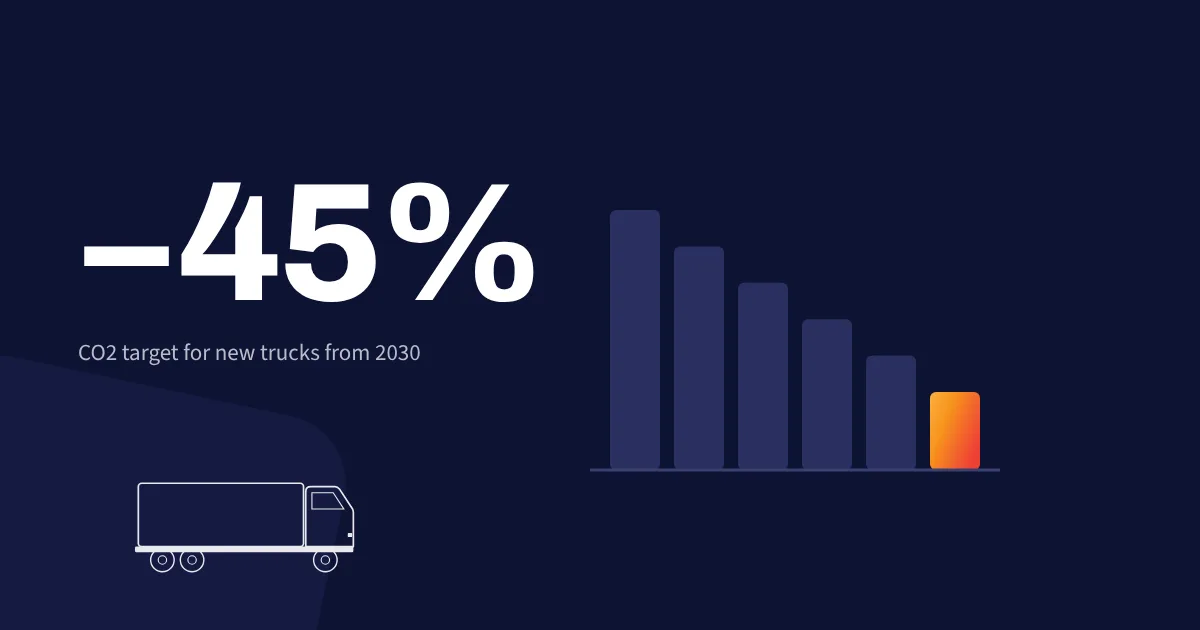
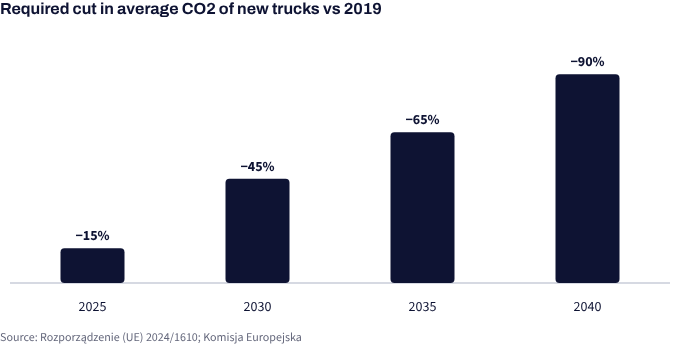
- From 2030 average CO2 emissions of new trucks must be 45% lower than in 2019, and targets also cover trailers (7.5%) and semi-trailers (10%).
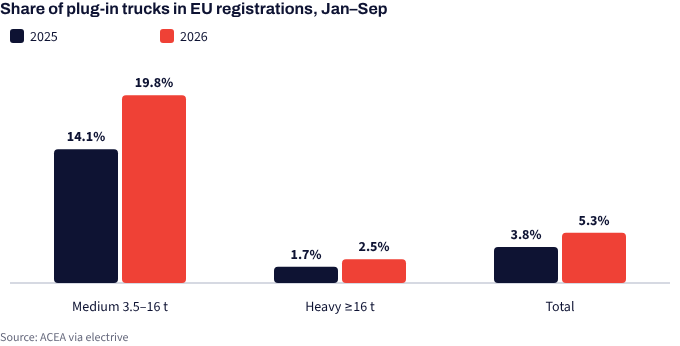
- From January to September 2026 plug-in trucks took 19.8% of registrations in the 3.5–16 t segment and 2.5% above 16 t.
- New machinery, tail lifts and cranes included, placed on the market from 20 January 2027 must meet Regulation (EU) 2023/1230.
- For buyers this means more attention to body weight and to powering equipment on electric chassis.
- −45% CO2 target for new trucks from 2030
- 19.8% electric share in 3.5–16 t, Jan–Sep 2026
- 20 Jan 2027 Machinery Regulation (EU) 2023/1230 applies
CO2 standards: 2030 is close
Vehicle manufacturers must cut average CO2 emissions of new trucks by 45% in 2030–2034, 65% in 2035–2039 and 90% from 2040, compared with 2019. From 2030 targets also cover trailers (7.5%) and semi-trailers (10%), and from 2035 vocational vehicles such as refuse trucks, tippers and concrete mixers.
Required cut in average CO2 of new trucks vs 2019
Source: Rozporządzenie (UE) 2024/1610; Komisja Europejska
| Target | |
|---|---|
| 2025 | −15% |
| 2030 | −45% |
| 2035 | −65% |
| 2040 | −90% |
Electric chassis in distribution
According to ACEA, from January to September 2026 plug-in trucks accounted for 5.3% of EU truck registrations: 19.8% in the 3.5–16 t segment and 2.5% above 16 t. Electrification starts with distribution, which means box bodies and reefers on medium chassis.
Share of plug-in trucks in EU registrations, Jan–Sep
Source: ACEA via electrive
| 2025 | 2026 | |
|---|---|---|
| Medium 3.5–16 t | 14.1% | 19.8% |
| Heavy ≥16 t | 1.7% | 2.5% |
| Total | 3.8% | 5.3% |
Timeline 2027–2035
| Date | Change | Relevance for bodies |
|---|---|---|
| 1 Jan 2027 | next ADR amendments | documentation for tankers and ADR vehicles |
| 20 Jan 2027 | Machinery Regulation (EU) 2023/1230 | tail lifts, cranes, compactors and other machinery on bodies |
| 29 May 2028 | Euro 7 for new heavy-duty vehicle types | changes on the chassis side |
| 29 May 2029 | Euro 7 for all new heavy-duty vehicles | changes on the chassis side |
| 2030 | CO2 targets: −45% trucks, 7.5% trailers, 10% semi-trailers | weight and aerodynamics |
| 2035 | CO2 targets for vocational vehicles | tippers, refuse trucks, concrete mixers |
Weights and dimensions
Since 2019 zero-emission trucks have had a 2 t extra weight allowance. A revision of the Weights and Dimensions Directive that may raise it is in trilogue. In October 2026 ACEA warned that the emerging compromise may fall short.
What follows (Trucklo's reading, not legal requirements)
- Body weight: will matter more, especially on electric chassis
- Powering equipment: cranes, refrigeration units and tail lifts on an electric chassis need agreement with the chassis maker
- Machinery documentation: equipment placed on the market from 20 Jan 2027 follows the new regulation
- Data: customers increasingly ask for temperature and equipment records
Frequently asked questions
How will truck bodies change over the next 5 years?
The biggest drivers are CO2 standards from 2030, the growing share of electric chassis in distribution and the Machinery Regulation from 2027. Body weight and equipment power supply will matter more.
Do CO2 standards apply to bodies?
They apply directly to vehicle manufacturers, and from 2030 also to trailers and semi-trailers. Vocational vehicles such as tippers follow from 2035.
When does Euro 7 apply to trucks?
To new heavy-duty vehicle types from 29 May 2028 and to all new ones from 29 May 2029.
Sources
- European Commission: agreement on CO2 targets for trucks
- electrive: ACEA Q1–Q3 2026, trucks and buses (29.10.2026)
- EUR-Lex: Regulation (EU) 2024/1257 (Euro 7)
- EUR-Lex: Regulation (EU) 2023/1230 on machinery (applies from 20 January 2027)
- Trans.info: ADR 2027 applies from 1 January 2027 (transition to 30 June 2027)
- Transport & Environment: weight limits for zero-emission trucks
- ACEA: Weights & Dimensions review, 20.10.2026
Trucklo routes truck bodywork enquiries to manufacturers who build them.