
W skrócie
- From January to September 2026, plug-in trucks held 5.3% of EU registrations (3.8% a year earlier).
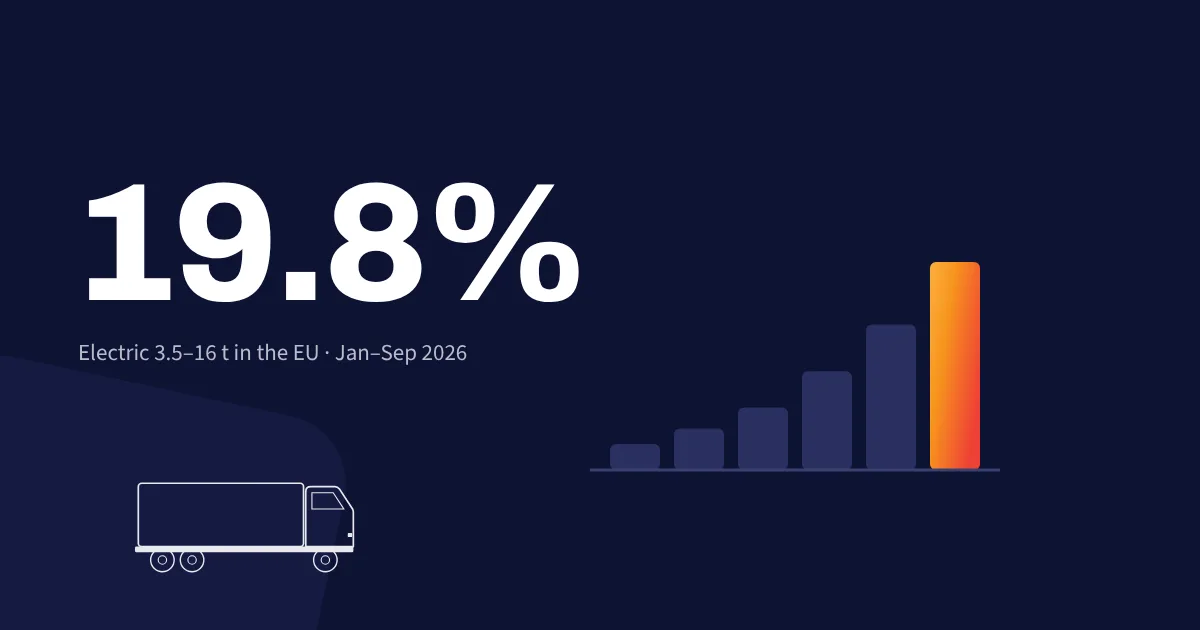
- In the 3.5–16 t segment the share is 19.8%; above 16 t it is 2.5%.
- Average CO2 of new trucks must fall 45% from 2030, 65% from 2035 and 90% from 2040, versus 2019.
- Targets cover semi-trailers (10%) and trailers (7.5%) from 2030, and vocational vehicles such as tippers from 2035.
- 19.8% electric in 3.5–16 t, Jan–Sep 2026
- −45% CO2 target for new trucks from 2030
- 91.7% diesel share of EU registrations, Jan–Sep 2026
How many electric trucks there are
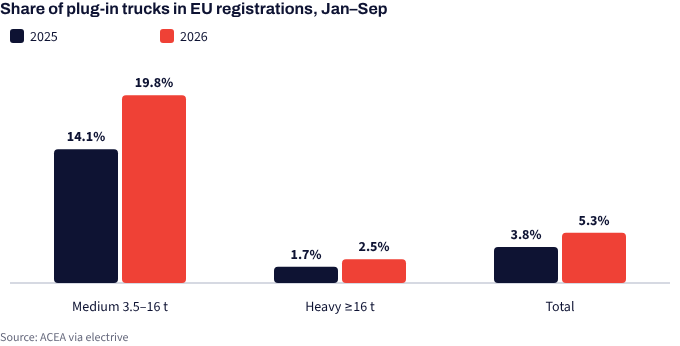
ACEA data for January–September 2026 show plug-in trucks at 5.3% of EU registrations, up from 3.8% a year earlier. Diesel still dominates with 91.7%.
The gap between segments is wide. In 3.5–16 t trucks, typical for distribution, the electric share reached 19.8% (7,753 units). Above 16 t it was 2.5% (5,120 units). Poland registered 135 medium electric trucks over the period, up 90%.
Share of plug-in trucks in EU registrations, Jan–Sep
Source: ACEA via electrive
| 2025 | 2026 | |
|---|---|---|
| Medium 3.5–16 t | 14.1% | 19.8% |
| Heavy ≥16 t | 1.7% | 2.5% |
| Total | 3.8% | 5.3% |
CO2 standards: the timeline to 2040
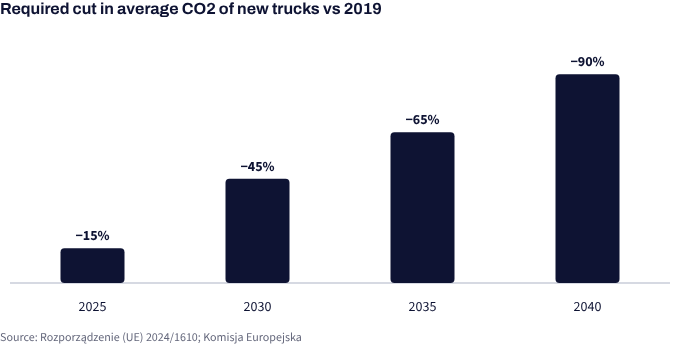
Under the agreement between the European Parliament and the Council, manufacturers must cut the average CO2 emissions of new trucks by 45% in 2030–2034, 65% in 2035–2039 and 90% from 2040, versus 2019. From 2035 the standards also cover vocational vehicles such as refuse trucks, tippers and concrete mixers. Trailers have a 7.5% target and semi-trailers 10%, from 2030.
Required cut in average CO2 of new trucks vs 2019
Source: Rozporządzenie (UE) 2024/1610; Komisja Europejska
| Target | |
|---|---|
| 2025 | −15% |
| 2030 | −45% |
| 2035 | −65% |
| 2040 | −90% |
Weight limits: negotiations continue
Batteries are heavy. Since 2019 zero-emission trucks have had a 2 t extra weight allowance. The European Parliament voted for 4 t, and the Council adopted an allowance that depends on the number of axles. The revision of the Weights and Dimensions Directive is in trilogue. In October 2026 ACEA warned that the emerging compromise may fall short.
What this means for the body
The points below are Trucklo's conclusions from the rules and data, not legal requirements.
- Body tare weight. On an electric chassis every kilogram of body reduces payload. Ask about body weight and materials: aluminium, composite, sandwich panels.
- Powering equipment. A loader crane, hook arm or refrigeration unit on an electric chassis needs power. Agree the solution with the chassis and body manufacturers before ordering.
- 12–16 t distribution goes first. Box and reefer bodies on medium chassis are where electric trucks grow fastest. Ask the builder about experience with electric chassis.
- Tippers and hooklifts from 2035. Vocational vehicles ordered today will still be working when the standards reach their segment.
Frequently asked questions
How many electric trucks are registered in the EU?
From January to September 2026 plug-in trucks held 5.3% of registrations: 19.8% in the 3.5–16 t segment and 2.5% above 16 t (ACEA).
Do the CO2 standards cover trailers?
Yes. From 2030 the target is 10% for semi-trailers and 7.5% for trailers.
How much extra weight do electric trucks get?
2 t since 2019. A revision of the Weights and Dimensions Directive that may change this is under negotiation.
Sources
- electrive: ACEA Q1–Q3 2026, trucks and buses (29.10.2026)
- European Commission: agreement on CO2 targets for trucks
- Transport & Environment: weight limits for zero-emission trucks
- Trans.info: EU truck weight rules, Council position
- ACEA: Weights & Dimensions review, 20.10.2026
Trucklo routes truck bodywork enquiries to manufacturers who build them.